
How to actually run a poop scoop business (without burning out by year two)
The unglamorous operational stuff that separates the operators who build something durable from the ones who quit after one rainy Texas summer.
By Poop Scoop Academy
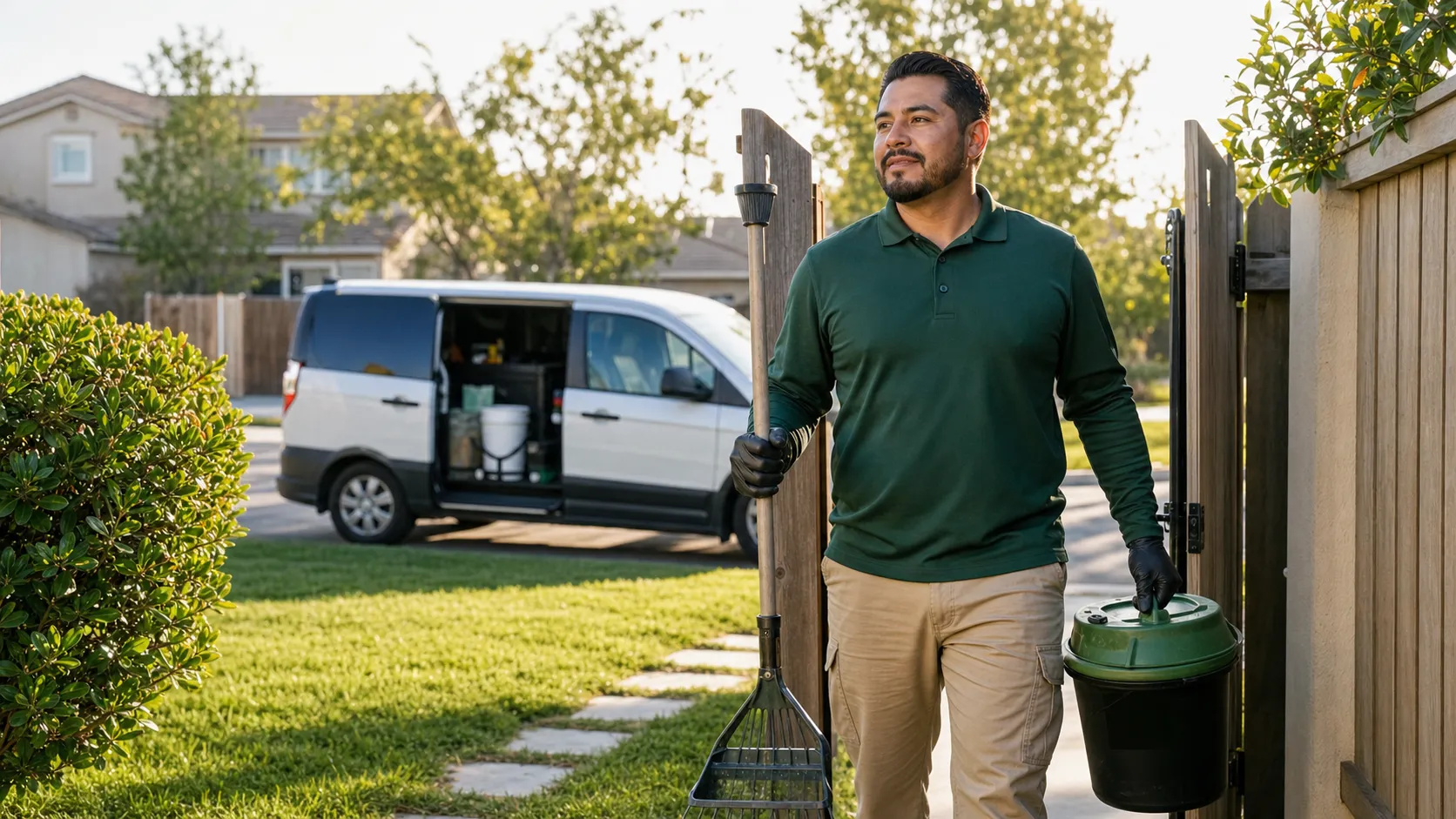
Most people start a scooping business because they want flexibility, fresh air, and a route they can grow on the side of a 9-to-5. Two years in, the ones who are still standing aren’t the ones with the best ads or the cutest trucks. They’re the ones who treated operations like a job from week one.
Here’s what that actually looks like.
Pick a service area before you pick a name
The biggest unforced error new operators make is starting wide. You service a 30-mile radius, drive 90 minutes a day between stops, and lose money on every yard.
Pick a zip code. Maybe two adjacent ones. Drive every street. Note the dog parks, the apartments with pet rent, the HOAs that look like they care. That is your service area for the first 12 months. Don’t expand until you have 60 weekly customers inside it.
Price like a real business, not a side hustle
If you’re charging $15 a visit because the guy on YouTube said that’s the going rate, you’re going to hate this business by month six. Hot take: most scoopers underprice by 30–50%.
A realistic starting price for a weekly one-dog yard is $20–25 per visit, billed monthly. Two dogs is $25–30. Three dogs is $30–35. Twice-weekly service is roughly 1.6x the weekly rate, not 2x. First-time deep cleans are $80–150 depending on yard size and how feral the back corner looks.
If a prospect balks at $25, they’re not your customer. Let them go. Don’t discount your way into a route full of unhappy bargain hunters.
Routing is a multiplier
You make money by stacking stops close together. That means filling the day geographically before you fill the day chronologically. New operators tend to book customers in the order they sign up, which means Tuesday is a 40-mile spaghetti loop.
Group stops by zip, then by neighborhood, then by side of the street if you can. Service Autopilot, Jobber, and Sweep are the three CRMs most operators land on — pick any of them and learn the routing module deeply before you launch.
Bill monthly, charge cards on file
Cash and Venmo will eat your evenings. Bill the whole month on the 1st, charge the card on file, done. Customers prefer it. Your bookkeeper prefers it. Your sanity prefers it.
If a card declines, you have a script (we keep one in the Skool):
“Hey [name], heads up — the card on file declined this morning. Can you update it in the portal? Service stays on while we get it sorted.”
No drama, no chasing, no awkward conversations at the gate.
Stock the truck like a route, not a garage
Two scoopers, two pairs of gloves each, two pairs of boots each, two waste buckets, four bags of lime, deodorizer, eco-safe disinfectant sprayer, zip ties, a roll of paper towels, a clipboard with the day’s manifest, and a spare phone charger. That’s the kit.
Bonus: keep a 10-pack of business cards in the door pocket. Every neighbor who asks “what are you doing?” is a free lead.
Track three numbers, not thirty
- Customers on the active route — total paying accounts.
- Average revenue per customer — your blended monthly per-customer number.
- Churn — accounts cancelled this month divided by accounts at the start of the month.
If those three numbers are moving in the right direction, you’re fine. If two of them are flat and one is sliding, that’s your week. Everything else is noise until you have 200 customers.
The unglamorous part
Spend an hour a week — Sunday night, coffee, music on — looking at your calendar, your bank statement, and your CRM dashboard. That’s the meeting that keeps this business from running you instead of the other way around.
If you want help setting any of this up, the Growth Hub has templates for every section of this post, and the community will tell you what’s actually working in their market this month. That feedback loop is the whole reason PSA exists.